


Key takeaways:
- Oil grooves distribute lubricant across the loaded face of a thrust washer, sustaining a continuous film that prevents metal-to-metal contact under high loads and at high speeds.
- Plain, ungrooved thrust washers are sufficient for low-speed, lightly loaded, or intermittent joints where a boundary film survives without active replenishment.
- Groove geometry – figure-8, double-8, or spiral – must be matched to duty cycle and lubrication method rather than applied by default.
- The additional machining cost of grooving is justifiable only where film stability genuinely limits component life.
Thrust washers sit at the intersection of load path and lubrication strategy. The decision to groove or leave a face plain determines how well a bearing survives high speed, heavy load, or continuous duty. Yet many engineers default to grooving without examining whether their application actually demands it. This look at Plain Thrust Bearings: Washers, Sleeves, and Custom-Machined Components is part of our broader coverage of Industrial Thrust Bearings.
Oil-Grooved vs. Plain Thrust Washers: Does Your Application Need Grooving?
An oil-grooved thrust washer carries machined channels across its bearing face, while a plain washer presents a continuous, ungrooved surface. The choice of either depends on how lubricant reaches and stays on the loaded interface.
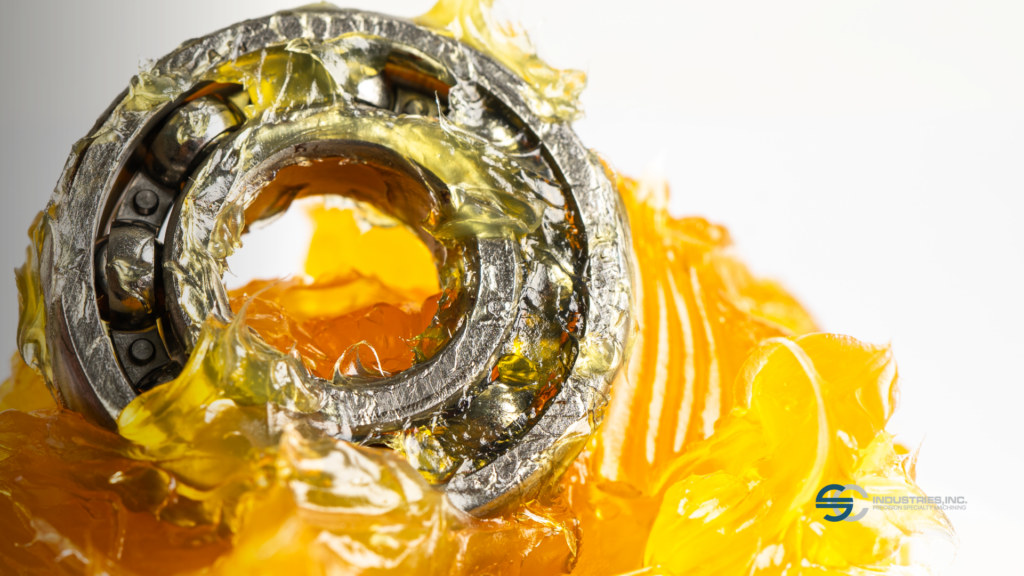
SC Industries machines several groove patterns: figure-8, double-8, and spiral, each engineered to route oil where a converging film is hardest to sustain; you can see the oil-groove patterns we machine in production. In effect, a grooved face behaves like an oil-embedded thrust bearing: the channels hold a lubricant reservoir and feed it outward under rotation, cutting friction and shear heat while extending service life in high-load, high-wear environments.
Surface features like grooves, pockets, and undulations promote a hydrodynamic film that separates the two faces, so relative motion occurs with minimal contact and reduces both friction and wear. Where loads are modest and motion intermittent, a plain washer holds an adequate boundary film on its own, and grooving there adds cost without measurable benefit.
When do I need oil grooves on a thrust washer?
Grooves become critical wherever a stable lubrication film is difficult to maintain:
- High-speed rotation, where centrifugal action strips lubricant from a smooth face faster than it can be replenished.
- Heavy or shock axial loads that squeeze the film toward metal-to-metal contact.
- Continuous-duty operation, where heat accumulates and lubricant viscosity drops.
In these regimes, oil-filled bearings and grooved thrust washers share one objective: holding lubricant at the interface long enough to sustain hydrodynamic separation. Engineers can tailor custom groove configurations to a specific duty cycle, using spiral patterns for progressive outward feed and double-8 layouts for bidirectional loading.
Spiral geometries are particularly effective because rotation itself pumps lubricant along the groove path, generating the pressure that keeps the two faces separated. Conversely, a plain washer may suffice when surface speed is low, loads are light and steady, and lubrication arrives continuously from an external system. The decision hinges on load, speed, and how oil actually reaches the face.
Do all bearings need lubrication?
Every bearing type – thrust washer, sleeve bearing, rolling element – depends on lubrication to reduce friction, wear, and heat. A bearing minimizes friction between parts, while lubrication sustains that smooth movement during operation. Strategies differ. Oil-filled bearings rely on a reservoir-fed or porous structure to supply lubricant continuously; grease-lubricated designs trap thickened lubricant at the contact; dry-running bearings use low-friction solids such as PTFE where oil is impractical, as in cryogenic service.
Design features like grooving change how much lubricant a surface retains and therefore how it is fed. Specifying the right approach for hardened and ground bushings means matching lubricant, geometry, and operating temperature to the load path. In high-demand OEM environments, the right lubrication strategy, whether through oil-filled bearings, engineered groove patterns, or advanced surface treatments, is essential for achieving the low defect rates and long-wearing, high-reliability performance SC Industries is known for.
What is the purpose of the oil groove in a plain bearing?
In a plain bearing, the oil groove distributes lubricant evenly across the bearing surface, minimizes friction, and prevents localized wear and overheating caused by a starved film. Without a channel to carry oil inward from the supply, lubricant concentrates near the inlet and thins across the load zone.
Precision-engineered grooves solve this: a figure-8 pattern circulates oil through the center of the face, while a spiral geometry feeds lubricant progressively toward the outer edge as it rotates. A properly cut grooved sleeve bearing or thrust washer maintains a more uniform film and stable operating temperature. Groove depth, width, and blend radius control flow, so they require tight tolerances rather than cosmetic cuts.
What do the grooves in a plain bearing sleeve do?
The grooves in a plain bearing sleeve act as distribution channels: they carry lubricant along and around the sleeve, maintain a consistent film between shaft and bore, and reduce the risk of metal-to-metal contact. Geometry and placement matter enormously. An axial groove feeds oil along the sleeve, while a helical path spreads it circumferentially as the shaft turns. Groove position relative to the load zone determines whether the film survives peak pressure.
A grooved sleeve bearing engineered for heavy-duty OEM service must place those channels precisely, as a misplaced groove interrupts the very film it is meant to support. In demanding equipment, correct groove configuration is the difference between predictable service life and premature failure. Additionally, a grooved sleeve bearing can be custom-designed to optimize lubricant retention and distribution for specific application requirements, ensuring maximum durability and operational reliability under severe loads and continuous duty cycles.
Grooving earns its cost in some applications and adds nothing in others; the right call depends on your loads, speeds, and how lubricant reaches the face. See the oil-groove patterns we machine, and if you remain unsure which your application needs, send us the operating conditions and we will advise.