


Key takeaways:
- Bronze alloys pair strong bearing performance with excellent machinability, making them a default choice for axial-load components.
- Bronze thrust bearings excel at absorbing axial loads while running against a steel counterface, especially when grooved for lubrication.
- Bronze is far softer than hardened steel, but its embeddability, conformability, and low friction often outweigh the advantages of steel’s raw hardness.
- Bronze outperforms brass in load capacity and wear resistance, while brass remains a lower-cost, higher-machinability option for light duty.
Selecting the right axial-load component starts with the material, and bronze remains one of the most trusted choices for heavy-duty service. This Bronze Thrust Bearings and Washers: A Buyer’s Guide breaks down SAE grades, hardness trade-offs relative to steel, and the bronze-versus-brass decision engineers face on the shop floor.
For a broader look at substrate options, see Thrust Bearing Materials: Bronze vs. Steel, part of our wider coverage of Industrial Thrust Bearings
What is the SAE standard for bronze bearing materials?
The SAE (Society of Automotive Engineers) classifies bearing bronzes by grade, with each number mapped to a controlled alloy chemistry and a defined set of mechanical properties. The most widely specified grade for sliding-contact duty is SAE 660 (cross-referenced as UNS C93200), a leaded tin bronze running roughly 83% copper, 7% tin, 7% lead, and 3% zinc. Tin supplies strength and wear resistance, lead improves machinability and adds a measure of self-lubrication, and zinc aids casting soundness.
Balancing load capacity, conformability, and cost, a 660 bronze bushing is the benchmark most engineers weigh other alloys against. Higher-tin grades such as C90700 trade some machinability for greater hardness and heavier load capacity, while aluminum bronzes step up strength again for shock-loaded work.
Across these grades, the practical takeaway from Bronze Thrust Bearings and Washers: A Buyer’s Guide is that chemistry drives behavior: our turning and boring experience shows alloys machine cleanly, hold tight tolerances, and take a consistent micro-finish without tearing. Each SAE grade also maps to a distinct set of applications and performance characteristics, which our precision machining history across OEM programs supports.
Where reliable long-wearing service is the priority, SAE 660 (C93200) is the workhorse for general-purpose bushings, thrust, and sleeve bearings under moderate-to-heavy loads with lubricated steel counterfaces, pumps, hydraulic cylinders, gearboxes, and construction and agricultural equipment. The higher-tin SAE 65 / C90700 grades deliver greater surface hardness and load capacity for slow-speed, high-load worm gears and heavily loaded bearings, at the cost of some machinability.
Aluminum bronzes handle shock and impact loading where a component must resist deformation under sudden peak forces. Leaded grades reward the OEM with self-lubricating tendencies and quieter running under marginal lubrication, while lower-lead and lead-free chemistries suit applications with cleanliness or compatibility constraints. The common thread is that specifying the alloy to the load, speed, and lubrication regime, rather than defaulting to a single grade, is what yields the durability heavy-duty service demands. Our estimating and machining teams routinely help OEMs make that match.
What is a bronze thrust bearing?
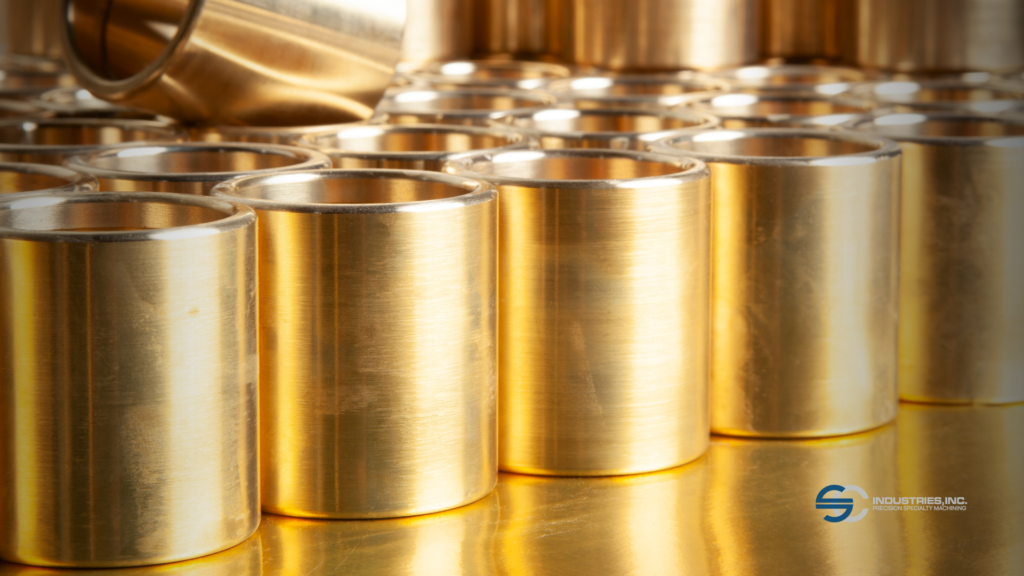
Bronze thrust bearings are ring- or pad-shaped components engineered to support axial loads – forces acting parallel to a shaft’s axis – while minimizing friction between a rotating collar and a stationary face. Bronze thrust washers are the flatter, simpler version of the same idea: a bearing-grade disc placed between two surfaces to absorb end thrust and control shaft float. Both thrive in heavy-duty industrial and OEM applications where a steel counterface slides against bronze under sustained pressure, particularly when the mating surface is lubricated. Manufacturing quality decides service life.
A blank is turned to size, faces are ground flat and parallel, and bearing surfaces are finished to controlled micro-finishes with low T.I.R., so load spreads evenly instead of concentrating on high spots. Oil-grooving is frequently added to carry lubricant across the face and flush debris. For a detailed comparison of grooved and plain designs, see Oil-Grooved vs. Plain Thrust Washers: Does Your Application Need Grooving?
Material selection and inspection matter as much as geometry. An ISO 9001:2015 quality system and disciplined metrology keep dimensional and surface results repeatable from prototype through production. In practice, the process moves from verified incoming material through multi-axis CNC turning on large-diameter turning centers, where the outside diameter, bore, and faces are brought close to net shape. This is followed by internal grinding and centerless grinding to hold the tight bores and concentricity that seating and running clearance demand. Where the print calls for it, contour, taper, or form turning, thread milling, and oil-grooving are added in the same disciplined sequence.
The result is precision tolerances measured in tenths, diametral control to roughly ±0.0005″, flatness and parallelism held on ground faces, and low T.I.R. on concentric features. Micro-finishes are commonly delivered in the 8–32 Ra range and finer where a running surface requires it. On the front end, choosing the correct bronze for the load, speed, and lubrication condition determines whether the finished tolerances actually translate into service life.
Quality control closes the loop. Metrology-driven inspection with calibrated gaging, combined where required with heat treatment and hardness verification, confirms every critical dimension against the customer print. Our Shop Management Manufacturing System ties inspection records to each order so results stay traceable and repeatable, a discipline that underlies our low defect rate from a single prototype through runs of up to 100,000 pieces.
Can bronze be as hard as steel?
No, in the metallurgical sense, bearing bronze is not as hard as hardened steel, and that difference is by design. A cast SAE 660 bronze typically measures around 60–65 HB (Brinell), while a through-hardened bearing steel such as 52100 reaches 58–64 HRC – an order of magnitude harder. Heat treatment closes that gap: quenching and tempering transform steel into a martensitic structure bronze alloys simply cannot reach.
So when comparing a steel vs bronze thrust washer, the question is rarely which is harder; it is which failure mode you are managing. Bronze’s relative softness is an advantage where embeddability and conformability matter, letting the surface absorb fine contaminants and tolerate slight misalignment rather than scoring a hardened shaft.
Where contact stress is extreme and abrasion dominates, hardened and ground steel bushings win. Matching the harder, precision-ground element to the softer, sacrificial one is the core of a sound design. For a deeper look at how material and hardness interact with failure mechanisms, see What Causes Thrust Bearing Failure? Causes, Prevention and Material Selection.
Is bronze or brass better for bearings?
For most true bearing duty, bronze is the better choice. Bronze is a copper-tin alloy whose tin content builds wear resistance and load capacity, while brass is a copper-zinc alloy that is easier to machine and less costly, but softer and more prone to galling under sustained pressure. Under axial load with a lubricated steel counterface, bronze’s higher strength and superior anti-friction behavior make it the dependable pick, and it grinds and grooves predictably in production.
Brass earns its place in light-duty, low-speed, or cost-sensitive fittings where wear demands are modest. Drawing on decades as a Bushing Specialist to OEMs, our recommendation in any Bronze Thrust Bearings and Washers: A Buyer’s Guide is straightforward: specify bronze when the component must carry real load and last; consider brass only when the application is genuinely undemanding.
This approach empowers buyers to make decisions grounded in real-world performance factors, load capacity, wear resistance, and service life, rather than focusing solely on upfront material costs or machining convenience. See our bronze bushing and bearing work for representative parts.
When the application calls for bronze’s mechanical and physical properties, grade selection can win the decision. Bring us your load, speed, and lubrication conditions, and we’ll match the alloy and finish to the job.