


Key takeaways:
- Plain washer-style thrust bearings transmit axial load through precision-hardened, ground sliding surfaces engineered for maximum durability and wear resistance. Alternative constructions utilize internal elements to separate raceways, but all are designed to manage axial forces with exacting control.
- Plain types excel in high-load, low-speed, and contaminated service; rolling-element types deliver lower friction and higher speed but demand cleaner, better-aligned conditions.
- Thrust bearings of every construction are engineered for axial (parallel-to-shaft) force, not radial loads.
- Robust plain construction resists shock and brinelling better than discrete rolling elements, making it the safer call under impact loading.
Unlike roller and ball bearings, which are susceptible to brinelling and surface fatigue under high impact, lateral loading, or vibration, precision bushings and plain thrust bearings distribute force across a larger surface area, significantly reducing localized stress and the risk of permanent deformation. This design advantage is critical for heavy-duty OEM applications where reliability under severe loading is essential.
Specifying the wrong thrust bearing shortens service life. The choice between plain and rolling-element designs hinges on construction and the method by which each converts axial force into bearing life. This comparison supplements Industrial Thrust Bearings and helps engineers self-select the right architecture for their duty cycle. Both types manage axial force, but they do so through fundamentally different mechanics that dictate where each one belongs.
For more on SC Industries’ approach to bearing durability and performance, see our Bearings & Bushings capabilities, and explore our Precision Machining Services for insight into our process controls and quality assurance standards.
Plain (Washer-Style) vs. Rolling-Element Thrust Bearings: What’s the Difference?
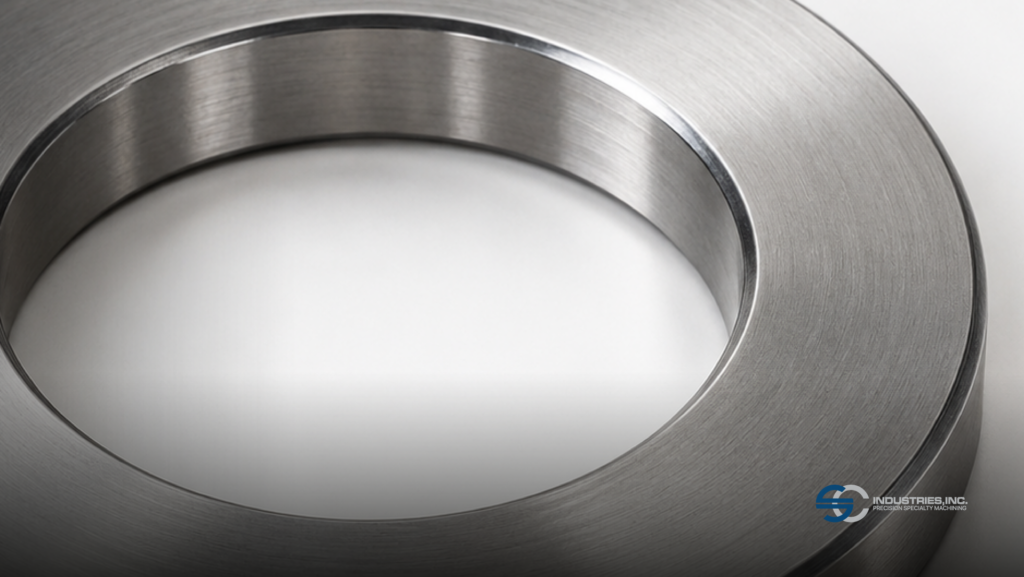
A plain thrust bearing is, at its core, a hardened and precision-ground thrust washer or bushing face that carries load through sliding contact. A rolling-element thrust bearing instead places balls, cylindrical rollers, or needles between two raceways, converting sliding friction into rolling friction. Roller thrust bearings and their ball and needle counterparts therefore run cooler at speed, but every rolling element, cage, and raceway adds a point of geometric sensitivity. Plain axial load bearings thrive in high-load, low-speed, and poorly lubricated or contaminated environments, where a continuous sliding surface spreads pressure and tolerates debris that would destroy a raceway.
Rolling-element designs offer lower starting friction and higher rotational speed, yet they are far less forgiving of misalignment, particle contamination, and impact. When an OEM application couples heavy axial load with dirt, moisture, or intermittent motion, the plain thrust washer is usually the durable choice. Precision washer-style thrust bearings machined to customer specification are exactly what SC Industries has produced for heavy-duty service for more than 75 years.
For a detailed look at custom machining, see Plain Thrust Bearings: Washers, Sleeves, and Custom-Machined Components.
What is the difference between radial bearings and thrust bearings?
The distinction comes down to load direction. A radial bearing supports force acting perpendicular to the shaft axis; for example, the weight of a rotor hanging in its housing. A thrust bearing, whether plain or rolling-element, is engineered to react to force acting parallel to the shaft. A radial thrust bearing blurs that line by accepting a combined load at an angle, but pure thrust designs are optimized for axial duty alone.
Selecting correctly means first resolving the load vector: a gearbox output shaft transmitting axial pushback needs thrust capacity, while a simple line-shaft support needs radial capacity. Matching the bearing to the dominant load direction is the single most consequential decision in the entire selection process. For an in-depth guide to application-specific selection, refer to How to Select and Specify a Thrust Bearing.
Can thrust bearings take radial loads?
Generally, no. Both plain and rolling-element thrust bearings are built to react to axial force, and their geometry offers little resistance to radial displacement. If you load a thrust washer or a rolling-element unit radially, contact pressure concentrates on a small area, driving premature wear, edge loading, and eventual failure. When an application genuinely sees both directions at once, the best bearing for axial and radial load is usually a combined arrangement – a thrust bearing paired with a dedicated radial bearing, or an angular-contact design sized for the resultant load. The engineering discipline is to quantify each load component and support it deliberately, rather than expecting one bearing to do a job it was never designed for.
Is thrust force the same as axial force?
In bearing engineering, the terms are interchangeable. Thrust force and axial force both describe load acting along the shaft’s centerline; the label “thrust” simply reflects the function of resisting that push.
In fact, axial load bearings are the precise engineering solution for managing this force. In heavy-duty service, this axial push can be substantial; turbine rotors, hydraulic cylinders, and vertical pump shafts all generate sustained loads that must be absorbed without letting the shaft migrate. Precision axial load bearings manage that force by presenting a flat, hardened, dimensionally stable surface that holds tolerance under continuous pressure, keeping the assembly located and preventing destructive end play.
Can thrust bearings handle shock loads?
This is where plain construction shows a decisive advantage. A washer-style thrust bearing presents a continuous hardened face with no discrete rolling elements to concentrate an impact. Therefore, it absorbs sudden axial spikes across its full bearing area. Roller thrust bearings and other rolling-element types are more vulnerable. An impact can dent a raceway, cause brinelling, or seed surface fatigue at the tiny contact patches where each element meets its track, initiating spalling that shortens life.
Specifically, roller thrust bearings, while capable of carrying significant axial loads, are particularly susceptible to brinelling under shock loads due to their discrete contact points. For presses, crushers, and other equipment where impact loading is routine, the robustness of a hardened, ground plain bearing is often the more reliable specification. Where shock is present, matching bearing architecture to the true duty cycle is essential.
Choosing between sliding and rolling contact ultimately comes down to load, speed, cleanliness, and impact, and each architecture owns a different corner of that map. If your application points toward a plain, sliding-contact thrust bearing, that is the work we do every day; our thrust bearing portfolio shows examples machined to customer specification. To move from specification to a validated part, request a quote from our estimating team.