


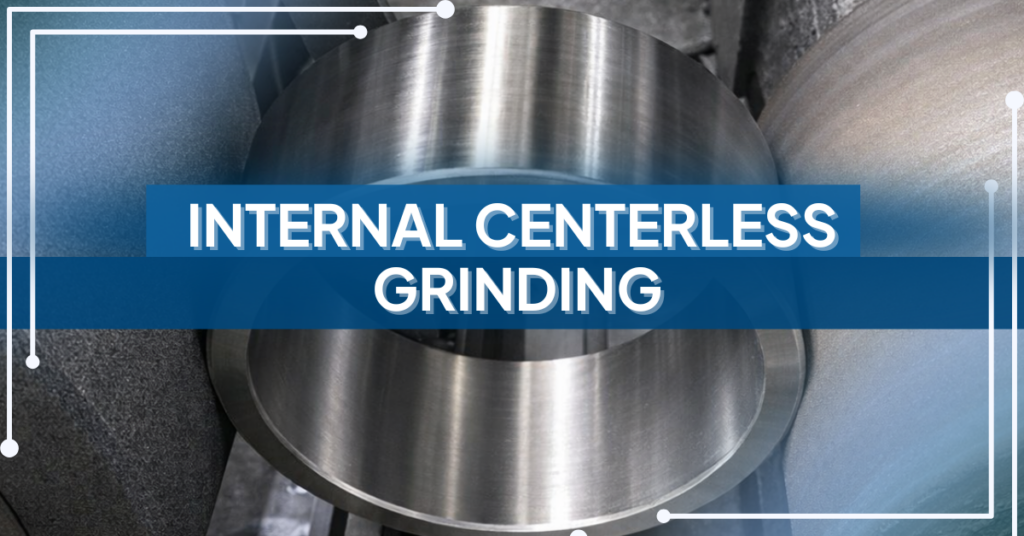
Centerless grinding is recognized as a high-precision, highly efficient machining method for removing material from cylindrical workpieces, achieving tight tolerances and smooth surface finishes. Unlike conventional methods that rely on centers or chucks, the technique supports the workpiece using a work blade between a grinding wheel and a regulating wheel.
While external centerless grinding is the principal configuration, Internal Centerless grinding is a specialized variation essential for finishing inner diameters, particularly in high-volume, precision manufacturing. This article explores the unique machinery, processes, and technical parameters specific to achieving the exceptional accuracy required in Internal Centerless grinding operations.
What is Internal Grinding?
Internal grinding is a machining operation used to finish the internal surface, or bore, of a cylindrical workpiece. This internal grinding process is typically necessary for finishing features like bearing raceways or the bores of ring-shaped components, which demand high precision. Two specific methods used in this process include the 2-shoe type and the 3-roll type, both utilized for finishing rings.
What is an Internal Grinding Machine?
An Internal grinding machine is specifically designed to accommodate the setup necessary for grinding inner diameters, utilizing supporting mechanisms tailored for ring-shaped or hollow workpieces. Centerless grinding machines generally utilize either a regulating wheel or a shoe to support and control the workpiece. The specialized Internal grinding machine may employ a shoe-type work support system, or, in the case of finishing small rings, a 2-roll-shoe configuration is used.
These machines eliminate the need for chucking and centering, which allows for very fast loading and unloading of workpieces, critical for high production volumes. In some applications, a small internal centerless grinding machine may be used for ring finishing, often incorporating support methods like magnetic backing plates.
What is Internal Cylindrical Grinding?
Internal cylindrical grinding refers to the precision machining method used to finish the bore of a part, ensuring the internal diameter is perfectly cylindrical and meets demanding size and roundness tolerances. Centerless grinding, including its internal variations, is essential for manufacturing precision parts in industries such as automotive and bearings, as it allows for the mass production of interchangeable spare parts.
Regarding what is internal grinding used for, this method is particularly crucial for finishing components such as bearing raceways and fuel injector valve bodies, where high accuracy and mechanical efficiency are essential. The ability of centerless grinding to support the workpiece along its length also makes it highly effective for achieving roundness requirements that may be less than 0.5 μm.
What is the Through-Feed Centerless Grinding Process?
The Through-Feed grinding process is the method where the workpiece travels axially and continuously through the grinding zone, allowing for extremely high production rates. In this process, the regulating wheel is set at a slight angle relative to the grinding wheel, which imparts the axial feed force necessary to move straight cylindrical parts continuously through the wheels. This eliminates the need for separate feeding mechanisms and is the basis for high-volume production of pins, needles, and cylindrical rollers.
Although often associated with external grinding, this methodology is fundamental to maximizing throughput in a specialized internal centerless grinding machine setup. Productivity in through-feed operations is determined by the combination of the regulating wheel speed and the feed angle.
Which Abrasive Wheel is Used Most Often in Centerless Grinding Operations?
The choice of abrasive wheel depends heavily on the material, stock removal rate, and required surface finish, but vitrified bond wheels – specifically those using CBN (Cubic Boron Nitride) or SiC (Silicon Carbide) – are commonly utilized in precision centerless operations. For high stock removal operations, a vitrified CBN wheel can be used at high grinding speeds. For final finishing, a vitrified SiC wheel might be preferred at lower speeds to achieve the final required surface quality.
The internal grinding wheel must also be precisely managed; rotary dressing systems are applied to minimize the runout of the wheels, sometimes achieving truing accuracy of 0.1 μm. Specialized long-life resinoid wheels have also been developed to ensure process stability and high stock removal capabilities in high-throughput applications.
Which Grinding Variable Measures the Rate of Regulating Wheel Rotation in Centerless Grinding?
The rate of regulating wheel rotation in centerless grinding is measured by its rotational speed. The regulating wheel serves the crucial function of controlling the workpiece’s rotation and feed rate. The workpiece rotational speed is directly related to the regulating wheel speed (and diameter) and is a fundamental parameter governing the stability and accuracy of the process. Regulating wheel rotational speed selection is especially critical in dynamic stability analysis; for example, stability maps often plot the stable versus unstable operating regions based on the regulating wheel speed alongside workpiece height.
How Do You Calculate Grinding Speed?
Grinding speed refers to the peripheral speed of the grinding wheel and is calculated based on the wheel’s diameter and angular velocity. nd is a key parameter affecting thermal damage and the process’s overall aggressiveness. For instance, in one calculation used for predicting grinding power, the grinding wheel peripheral speed is integrated alongside parameters like infeed speed and the width of cut.
What Are the Angles for Centerless Grinding?
The primary angles defining the geometric setup in Centerless Grinding are the workrest blade angle and the center-height angle, which determines the workpiece center’s position relative to the wheel centerline. The Workblade angle, also referred to as the blade tilt angle, is a critical set-up variable that influences both geometric stability (lobing) and the workpiece’s bending during grinding. Similarly, the workpiece position is defined by the center-height angle, a very critical parameter affecting accuracy and stability. In through-feed operations, the regulating wheel also uses a slight angle to the grinding wheel axis to generate the axial feed motion.
Conclusion
Internal cylindrical grinding performed using centerless methods provides a unique solution for achieving ultra-precision finishes and tight dimensional control required for components like rings and bearing bores. By eliminating chucking and exploiting the self-centering geometry, the internal centerless grinding machine ensures high productivity, often achieving roundness accuracy below 0.5 μm and drastically reducing cycle times.
Achieving these exceptional results requires expert knowledge of complex technical variables, including geometric angles, wheel composition, and stability parameters. We invite you to leverage our specialized expertise and advanced machinery for your most demanding precision component needs. Call 216-732-9000 or Request Quote / Contact Centerless Grinding today.