


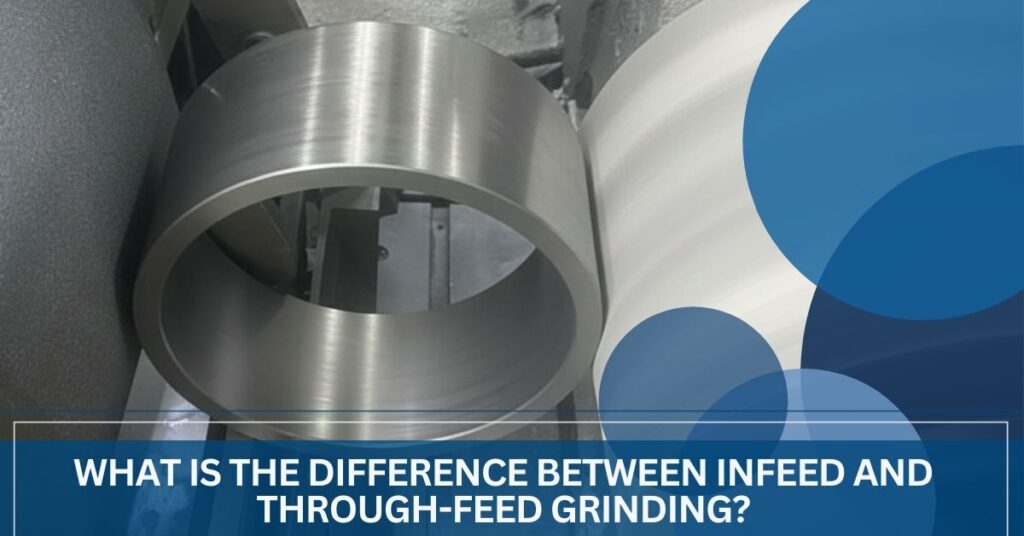
In precision machining, understanding grinding techniques is essential for optimizing manufacturing processes and achieving superior component quality. Infeed and through-feed grinding are two fundamental centerless grinding methods, each suited to specific part geometries and production requirements.
This high-productivity finishing technology generates precision parts by supporting the workpiece without fixed clamping points, drastically reducing production time and improving size accuracy. The core difference lies in the direction and movement of the workpiece, which determines the geometry of the final part. For a broader understanding of the Types of centerless grinding, refer to our Centerless grinding page.
What is feed grinding?
Feed grinding refers to operational modes within centerless grinding—primarily through-feed and in-feed (plunge)—that define how the workpiece interacts with the grinding wheel and regulating wheel for material removal. This process achieves precise dimensions and surface finishes while eliminating clamping and centering operations, helping to lower cycle times.
Applications requiring symmetrical construction or continuous production of parallel cylindrical components, such as long bars, pins, cylindrical rollers, and shafts primarily comprise what through feed grinding is used for. This method allows continuous grinding of multiple parts, enhancing productivity and efficiency for high-volume production runs.
Typical materials processed include metals such as steel, aluminum, and titanium, plastics for lightweight components, and ceramics for high wear resistance applications.
What is the difference between infeed and through-feed?
Through-Feed Grinding
In through-feed grinding, the workpiece is continuously axially positioned between the grinding and regulating wheels, producing a consistent cylindrical shape along its entire length, resulting in a cylindrical shape along its entire length. Advanced technology enables production of precision rollers with roundness accuracy of 0.1–0.3 µm at throughput of 250–350 pieces per minute.
Advantages: Higher production rates, minimal setup time for identical parts, ideal for high-volume production of uniform diameter parts.
Disadvantages: Limited to consistent diameters and symmetrical shapes, less flexibility for complex geometries.
Applications: Best for producing pins, shafts, rollers, and cylindrical components.
Infeed Grinding
Infeed grinding (plunge grinding) involves positioning the workpiece in a fixed axial location while the grinding wheel is fed radially to achieve the final profile. The workpiece is held in a fixed axial position during the process.
Advantages: Greater flexibility in part shapes, ability to achieve tight tolerances and complex profiles, ideal for intricate designs with shoulders or projected surfaces.
Disadvantages: Slower production rates, more setup time required for each configuration.
Applications: Ideal for bushings and bearings. SC Industries manufactures hardened and ground bushings and bearings with tolerances as tight as ±0.0004″ or ±0.0005″.
What is the unit of grinding feed rate?
The grinding feed rate refers to the controlled speed at which the workpiece or grinding wheel advances during material removal. It is a critical parameter influencing efficiency and quality.
Common units include inches per minute (IPM) or millimeters per minute (mm/min) for axial movement, millimeters per second (mm/s) for faster operations, and cubic millimeters per minute per Newton (mm³/min/N) for metal removal parameters.
The feed rate impacts surface finish—lower rates produce finer finishes, while higher rates can lead to rougher surfaces. SC Industries achieves micro-finishes down to 8-16 micro or 16 RMS. The feed rate also directly affects material removal rate and overall productivity.
What is the surface speed of the regulating wheel in Centreless grinding?
The surface speed of the regulating wheel is critical for control of the rotational speed of the workpiece and directly affects productivity and component quality. The regulating wheel rotates at a significantly lower surface speed than the grinding wheel and directly controls workpiece rotation and feed rate.
By adjusting this speed, operators control the time the workpiece spends in contact with the grinding wheel, influencing material removal rate, process stability, and surface finish quality. Manufacturers must consider material hardness, abrasive type, and required tolerances. Surface speed also affects heat generation, impacting workpiece metallurgical properties and grinding wheel longevity.
What is a through-feed grinding wheel?
A through-feed grinding wheel is specifically designed to support continuous axial movement of the workpiece during through-feed grinding operations. These are typically wide abrasive wheels designed to accommodate the continuous, axial motion of the workpiece through the grinding gap.
Characteristics: Cylindrical shape allowing continuous feeding. Material composition includes aluminum oxide for ferrous metals, silicon carbide (SiC) for non-ferrous materials, and diamond or Cubic Boron Nitride (CBN) for extremely hard materials.
Utilization: These wheels work with regulating wheels in centerless grinding setups, performing material removal while the regulating wheel controls workpiece rotation and feed rate. Understanding what is a through feed grinding wheel is essential for selecting the right tools for specific applications.
Creep feed grinding: an advanced technique
Creep feed grinding is an advanced technique characterized by extremely slow feed rates, combined with deep cut depths, enabling high material removal rates while achieving high precision. This method is beneficial for producing complex geometries while maintaining high precision and excellent surface integrity.
Applications: Manufacturing intricate parts requiring tight tolerances and grinding hard materials such as tool steels, ceramics, and composites.
Benefits: High precision, superior surface finish quality, surface integrity, and ability to machine complex geometries.
Challenges: Slower production rates, increased wheel wear due to deeper cuts, and managing heat generation, requiring specialized cooling systems.
Grinding wheel types and uses
Grinding wheel types and uses are classified based on abrasive material, bond type, and structure, determining their suitability for specific workpiece materials and desired finishes.
Common Types: Aluminum oxide wheels for ferrous materials, silicon carbide (SiC) wheels for non-ferrous materials and fine finishes, diamond wheels for extremely hard materials like ceramics, and Cubic Boron Nitride (CBN) wheels for hardened steel.
The abrasive material is suspended in a binding agent such as vitrified bonds, offering rigidity, or resin bonds, providing flexibility and cooler cutting action. Selecting the appropriate wheel type is key for optimal results.
Understanding the differences between infeed and through-feed grinding is vital for manufacturers seeking to optimize machining processes. By selecting the appropriate method based on production needs, organizations can achieve high-quality components with precise tolerances while maximizing efficiency. With over 75 years of experience and ISO 9001:2015 certification, SC Industries delivers hardened and ground bushings, bearings, and induction hardened pins meeting the highest standards.
Ready to elevate your precision machining capabilities? At SC Industries, we bring over 75 years of expertise in centerless grinding. Whether you need high-volume through-feed grinding or complex infeed grinding solutions, our team is here to help. Request a quote today and discover how our precision manufacturing can transform your production processes!