


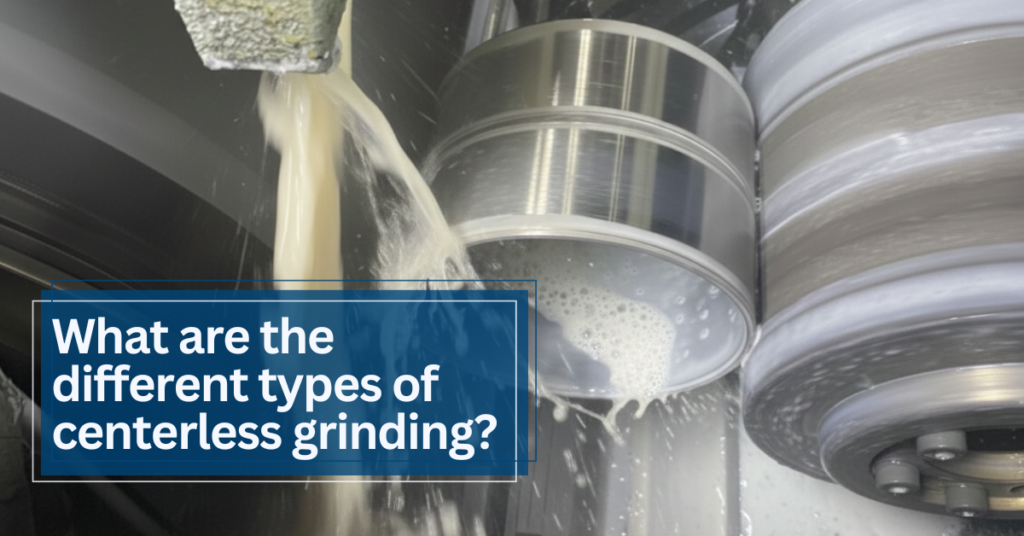
Centerless grinding is a critical process in the manufacturing sector, known for its efficiency and precision in shaping materials. As industries evolve, understanding the various types of centerless grinding methods becomes essential for optimizing production and enhancing product quality.
In this article, we will explore the different types of centerless grinding, their applications, and how they can benefit your manufacturing processes.
Types of centerless grinding?
Through-Feed Grinding
In through-feed grinding, a workpiece is fed into the machine with two support guides so it rotates while sitting between both the regulating and the grinding wheels. This allows for a completely symmetrical construction or the production of parallel parts, including rollers and pins in aerospace equipment. Another popular use of through-feed grinding is feeding long bars between the two wheels to produce a finished bar with a precise diameter.
In-Feed Grinding
Also called plunge grinding, in-feed grinding processes are commonly used for grinding projected, formed surfaces, shoulders, and parts with complex geometries, multiple changes in diameter, and other intricate designs. In this setup, the regulating wheel radially feeds the workpiece against the grinding wheel to produce the complex final shape.
End-Feed Grinding
End-feed grinding produces tapered parts by carefully controlling the extent of the grinding process. It’s similar to through-feed grinding in that the workpiece is fed into the centerless grinding machine against the regulating wheel and grinding wheel, but the part is stopped before it can fully go through the machine. This creates a tapered grinding effect.
What is centerless grinding?
Centerless grinding is a machining process that uses abrasive cutting to remove material from a workpiece. Unlike traditional grinding methods, where the workpiece is mounted between two centers, in centerless grinding, the workpiece is supported by a work rest blade and the grinding wheel. The key components involved include:
- Grinding Wheel: The primary tool used for material removal.
- Work Rest Blade: Supports the workpiece during grinding.
- Regulating Wheel: Controls the rotational speed and position of the workpiece.
This method is particularly important in manufacturing due to its ability to produce high volumes of precision parts with minimal human intervention.
Recent advancements in grinding wheel technology have introduced wheels designed specifically for high-speed applications, enhancing both the efficiency and lifespan of the grinding process. These specialized wheels can significantly improve material removal rates while maintaining surface quality, making them ideal for high-volume production environments.
What is plunge cut grinding?
Plunge grinding is a type of centerless grinding where the grinding wheel moves vertically down onto the workpiece. This process is especially useful for producing complex shapes and features on cylindrical parts. Is the common term used for In-Feed Grinding. The defining characteristic of plunge cut grinding is the radial feed direction of the workpiece relative to the grinding wheel
Plunge grinding applications:
- Producing grooves and slots
- Shaping parts with varying diameters
Advantages:
- High precision for intricate shapes
- Efficient for small batch production
Limitations:
- Slower than other methods for larger parts
- More complex setup required
Utilizing advanced CNC controls can enhance plunge grinding setups, allowing for more precise adjustments and automated processes to reduce setup time and improve overall efficiency.
What is through-feed grinding?
Through-feed grinding is a continuous process where the workpiece is fed through the grinding and regulating wheels. This method is ideal for cylindrical parts that are uniform in diameter.
Operational mechanics:
- The workpiece enters the grinding zone.
- The regulating wheel rotates, pulling the workpiece through.
- The grinding wheel removes material as the workpiece passes through.
Best-suited materials:
- Steel
- Aluminum
- Various plastics
This method, known as the through-feed centerless grinding process, is highly efficient for high-volume production runs.
Incorporating automated feeding systems can further streamline the through-feed grinding process, reducing manual handling and increasing throughput. These systems can be programmed for different part sizes, enhancing flexibility in production.
What is out feed grinding?
Out-feed grinding is a variation of centerless grinding where the workpiece is ground as it exits the grinding zone. This method differs from plunge and through-feed grinding by focusing on finishing operations.
Specific applications:
- Finalizing the dimensions of cylindrical parts
- Achieving a smooth surface finish
Benefits of out-feed grinding:
- Enhanced surface quality
- Greater control over final dimensions
This method is particularly advantageous for parts requiring a high degree of accuracy and finish.
Implementing in-process gauging systems during outfeed grinding provides real-time feedback on part dimensions, allowing for immediate adjustments and ensuring that specifications are consistently met.
Which method of centerless grinding is used to produce a taper?
To achieve tapered parts in centerless grinding, specific techniques such as end-feed grinding, adjusting the angle of the work rest blade, and regulating the wheel’s position are employed. This allows for precise control over the taper angle and ensures uniform material removal.
Importance of precision in taper grinding:
- Ensures proper fit in assemblies
- Reduces wear and tear on mating parts
Achieving the correct taper is crucial for applications in automotive, aerospace, and other precision-dependent industries.
Utilizing simulation software can aid in the design and setup of taper grinding processes, allowing engineers to visualize and optimize the grinding parameters before actual production, thereby reducing trial-and-error setups.
What is the angle of the work rest blade for centerless grinding?
The angle of the work rest blade is a critical factor in the centerless grinding process.
The angle of the work rest blade is a critical parameter in the centerless grinding setup. The appropriate angle is often chosen or optimized depending on the specific machine configuration and desired grinding stability or accuracy.
Around 60°: This angle is stated as the value the blade is generally set at when performing an in-feed centerless grinding technique.
Around 30°: This angle was also listed as the blade angle for an infeed grinding process used in experimental validation for stability analysis
Significance of the work rest blade angle:
- Affects the stability of the workpiece
- Influences material removal rates and surface finish
Adjusting the angle can optimize the grinding outcome, ensuring efficient material removal and a superior finish.
Regular maintenance and calibration of the work rest blade angle can significantly impact the longevity of the grinding equipment and the quality of the finished parts. Utilizing precision measurement tools helps ensure the angle remains consistent throughout the production run.
Advanced considerations in centerless grinding
As technology advances, micro centerless grinding has emerged as a specialized method allowing for the production of extremely small and precise components. This technique is particularly useful in industries such as medical device manufacturing and electronics.
Future trends in centerless grinding:
- Automation and robotics for enhanced efficiency
- Advanced materials and grinding wheels for improved performance
These innovations are set to transform the landscape of centerless grinding, making it even more integral to modern manufacturing.
The integration of machine learning algorithms in centerless grinding processes facilitates predictive maintenance, identifying potential issues before they affect production to minimize downtime and enhance operational efficiency.
Discover how centerless grinding can enhance your manufacturing precision and efficiency. For expert insights and tailored solutions, connect with SC Industries at www.scindustriesinc.com. Explore our offerings and transform your approach to grinding today!